
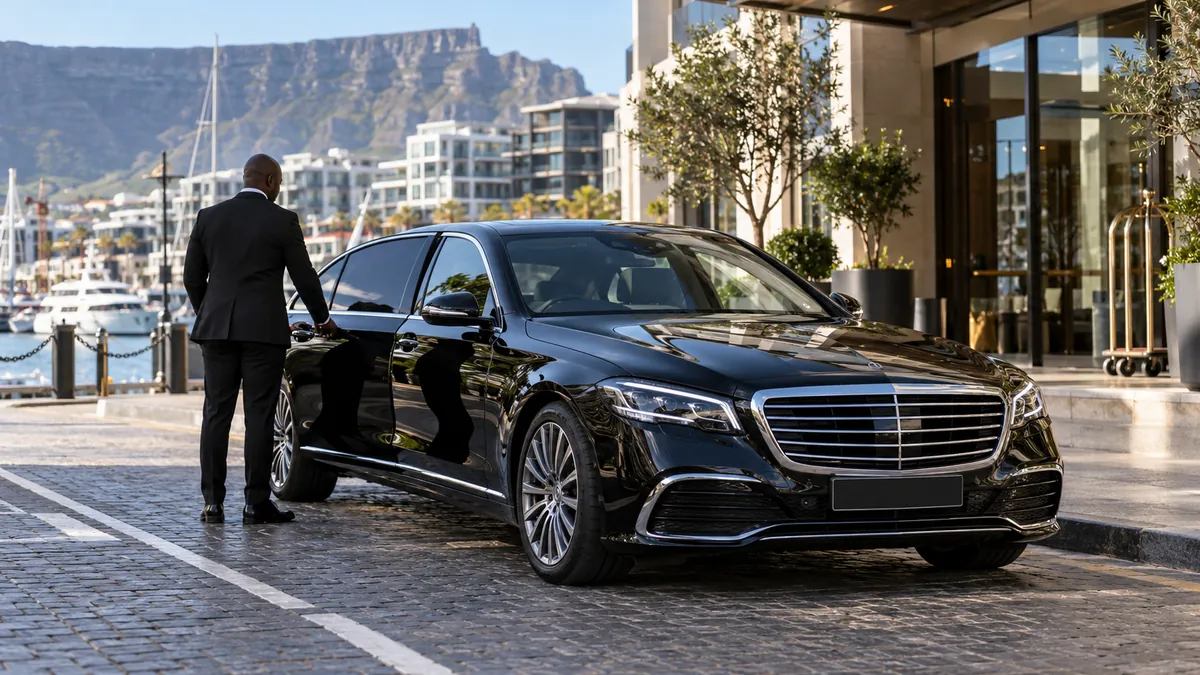
Cape Town Bus Rental provides chauffeur-driven group transport for 1–4 passenger car with driver Cape Town. The service is designed around practical movement rather than a fixed sightseeing timetable, so groups can plan hotel collections, airport arrivals, conference schedules, restaurant stops, attractions and onward journeys around their own programme. For Cape Town and the Western Cape, vehicle selection should consider passenger count, luggage volume, accessibility requirements, road access and how many separate stops are included.
Cape Town combines dense central streets, mountain roads, coastal routes and longer intercity corridors. That makes route planning important for every vehicle hire booking. Pickup points around the CBD, V&A Waterfront, Sea Point, Camps Bay and the Atlantic Seaboard can experience congestion at peak times, while destinations such as Cape Point, Stellenbosch, Franschhoek and Hermanus require realistic journey allowances. A private vehicle keeps the group together and reduces the need to coordinate several taxis or ride-hailing cars.
Choosing the right vehicle for 1–4 passenger car with driver Cape Town
Small parties can use cars, MPVs and minibuses, while medium and large groups are generally better suited to mini-coaches and full-size coaches. The most suitable capacity is not always the smallest vehicle that can technically seat the group. Airport passengers with large suitcases, golf groups, sports teams, conference delegates with exhibition materials and touring groups may need additional luggage space. Executive specifications can also be requested where the journey requires a more premium presentation.
Available specifications vary between vehicles and suppliers, but common requests include air conditioning, reclining seats, large luggage holds, USB or charging points, microphones, PA systems and upgraded interiors. Groups should identify essential requirements at the quotation stage rather than assuming every vehicle carries the same equipment. Large movements can be handled with several vehicles travelling in coordinated waves.
Planning pickups and access in Cape Town and the Western Cape
Coach access in Cape Town is different from car access. Some central hotels, residential streets, beach roads and heritage areas have limited kerb space or are unsuitable for a large vehicle to wait. A nearby legal loading point may therefore be better than insisting on a door-front pickup. For major attractions and event venues, the final meeting point should be shared clearly with passengers before the journey begins.
For airport work, flight numbers help the transport team account for delays and terminal changes. For conferences and events, organisers should provide the registration opening time, session start, venue access instructions and expected loading windows. For tours, a realistic schedule should include time for comfort stops, attraction entry, meal breaks and seasonal traffic. South African driver-hours and operating rules also need to be reflected in longer itineraries.
Popular uses for 1–4 passenger car with driver Cape Town
Private buses and coaches are used for airport transfers, corporate meetings, conferences, weddings, schools, sports teams, cruise passengers, film and production movements, incentive groups, wine tours, day trips and multi-day South African itineraries. Cape Town International Airport, the CTICC, DHL Stadium, the V&A Waterfront and the Cape Town Cruise Terminal create regular group movements, while leisure itineraries often connect Table Mountain, Cape Point, Boulders Beach, Kirstenbosch and the Winelands.
Useful route considerations
- Confirm luggage volume as well as passenger count.
- Request required features when asking for a quotation.
- Allow suitable pickup space for larger vehicles.
What to include in a quote request
For an accurate transport quotation, provide the travel date, requested pickup time, exact pickup and destination, passenger count, luggage estimate, expected finish time and every planned stop. Airport bookings should include the flight number. Cruise transfers should include the ship name and scheduled berthing information where available. Event planners should include venue access notes and any requirement for repeated shuttles.
Pricing depends on vehicle type, distance, duration, waiting time, operating hours, access costs, parking, tolls where applicable and the complexity of the itinerary. Rather than relying on a generic per-kilometre figure, a journey-specific quote is the clearest way to understand the total transport requirement. Changes made after confirmation may affect availability or price, particularly during peak tourism periods, major events and school holidays.
Book 1–4 passenger car with driver Cape Town with a driver
The service is supplied with a professional driver and is intended for private group transportation. Before confirming, review the itinerary, vehicle capacity and included items on the quotation. For journeys beyond Cape Town or multi-day touring, accommodation, driver expenses and legal driving-time requirements may need to be incorporated. Contact Cape Town Bus Rental with the complete route so the booking can be matched to an appropriate vehicle and operating plan.